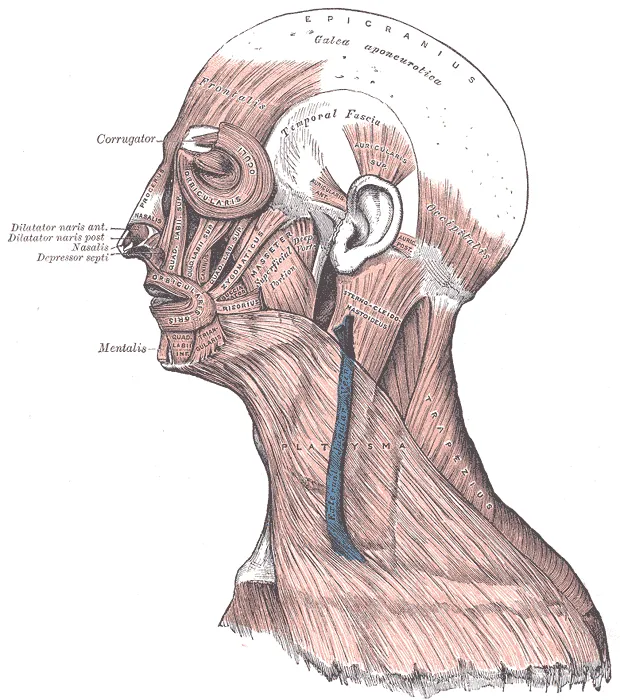
Part 2.7: Head & Neck — The Occipitofrontalis Muscle
When people talk about tension headaches, forehead tightness, or that feeling of a “heavy scalp,” they rarely think about the Occipitofrontalis muscle — but this broad, sheet-like muscle can quietly contribute to the discomfort we feel across the forehead and top of the head.
Where Is the Occipitofrontalis?
The Occipitofrontalis is a unique muscle that runs like a cap over the top of your skull. It has two main parts:
Frontal belly (frontalis): This portion sits at the forehead and eyebrows.
Occipital belly (occipitalis): This portion anchors at the back of your skull, near the base.
The two bellies are connected by a tough sheet of connective tissue called the Galea Aponeurotica. This structure helps the muscle work as a unit — when you raise your eyebrows in surprise, that’s your Occipitofrontalis in action.
What Does the Occipitofrontalis Do?
Raises your eyebrows: Think surprise, curiosity, or concentration.
Moves the scalp slightly backward and forward: Subtle but important for facial expression.
Contributes to forehead tension: When you hold your brows up for extended periods — like staring at a screen or focusing intensely — this muscle can stay contracted for hours.
Referred Pain Patterns: What You Might Feel
Trigger points in the Occipitofrontalis can create a dull, band-like headache that can be mistaken for a tension headache or even mistaken for sinus pressure.
Common referred pain patterns include:
Across the forehead: A tight, pressing sensation above the eyebrows.
At the temples: Pain can spread toward the sides of the head.
Over the crown: Some people feel tenderness at the top of the head.
At the back of the skull: If the occipital belly is involved, you might feel pain near the base of the skull.
How Do Trigger Points Form Here?
Facial expressions: Holding your brows up or frowning repeatedly can keep the muscle partially contracted.
Posture: Forward head posture can subtly strain the muscles that anchor the scalp.
Stress and concentration: Deep focus often leads to unconscious forehead tension.
Scalp tension: Poor sleep positions or wearing tight hats can also contribute.
Signs to Watch For
Persistent forehead tightness that doesn’t resolve with sinus treatments.
A heavy feeling across the top of your head.
Tension headaches that wrap from the forehead to the back of the head.
Tenderness when you press just above the eyebrows or at the base of the skull.
The Takeaway
The Occipitofrontalis doesn’t get much attention, but it plays a big role in how tension is held across the scalp and forehead. Learning to soften your brow, practice gentle self-massage, and adjust postural habits can go a long way toward easing these tension patterns.
Next Up
In Part 2.8, we’ll continue with the Head & Neck region, looking at the Suboccipital muscles — those tiny yet mighty muscles at the base of your skull that often contribute to neck stiffness, headaches, and even dizziness.


